How Piracy Spread Across Social Media Platforms
The conversation around piracy has always defaulted to the same image: dark-interface websites, relentless pop-ups, suspiciously free-to-access domains. Over the years, this picture became so ingrained that for much of the industry, identifying the threat and identifying pirate websites became one and the same. The address was known. The response was only built around it.
But this is only one side of the story. Pirate websites are still part of the problem. The mistake is assuming they’re still the whole problem.
The rise of pirate websites runs parallel to the internet’s own growth story. From The Pirate Bay to Putlocker, from 123movies to Popcorn Time to illegal streaming sites, the model was consistent: a central address, a large catalogue, millions of users. The industry’s response shaped itself accordingly. Where the threat was, the fight was. Perception locked in accordingly. Seeing only this part of the picture became, at best, an industry blind spot at worst, a head buried firmly in the sand.
Visits to pirate sites declined by roughly 6% in years. So did that mean piracy was shrinking? Not at all. Asia Video Industry Association’s (AVIA) Coalition Against Piracy research tells a story. While piracy via TV boxes, apps and torrent sites declined, the overall piracy rate rose from 52% to 59%, driven entirely by social media and messaging platforms. Social media-based piracy stood at 49% in 2021, 52% in 2023, and 59% in 2024. The chart is unambiguous: every traditional piracy channel is declining. Social media is the only one moving in the other direction.
Looking at how audiences consume content today, the shift is hardly surprising. Audiences have always followed convenience. As new platforms changed viewing habits, piracy adapted right alongside them. It adapted to the scroll, to the feed, to the format. It showed up where your target audience was already spending their time. That shift didn’t happen overnight, and it didn’t happen in one place. To understand where it led, it helps to trace how it began.
How Social Media Piracy Replaced the Pirate Site Model
It started with streaming. UGC platforms like YouTube and Dailymotion opened the first new door. Users could now stream rather than download, and content of every kind found a home on these platforms. The demand was there, and piracy followed it. Across all of them, tracking and enforcing against infringing content remained the responsibility of rights holders. Piracy recognised the appetite before the industry did, and it spread quickly.
Social media was the next and perhaps inevitable wave. Platforms built around user-generated content were never designed as distribution channels for piracy, yet that is exactly what piracy turned them into. Facebook groups with tens of thousands of members turned into direct film-sharing hubs, leaving rights holders to carry the enforcement responsibility largely on their own. On Instagram, film scenes were reformatted as Reels, circulating under the cover of fan edits. Over time, that cover became a piracy format in its own right, generating significant traffic and reach. X was no different. In one of the more widely documented cases, Spider-Man: Across the Spider-Verse was illegally uploaded in its entirety, stayed live for roughly 12 hours, and accumulated an estimated 340,000 views before it was taken down.
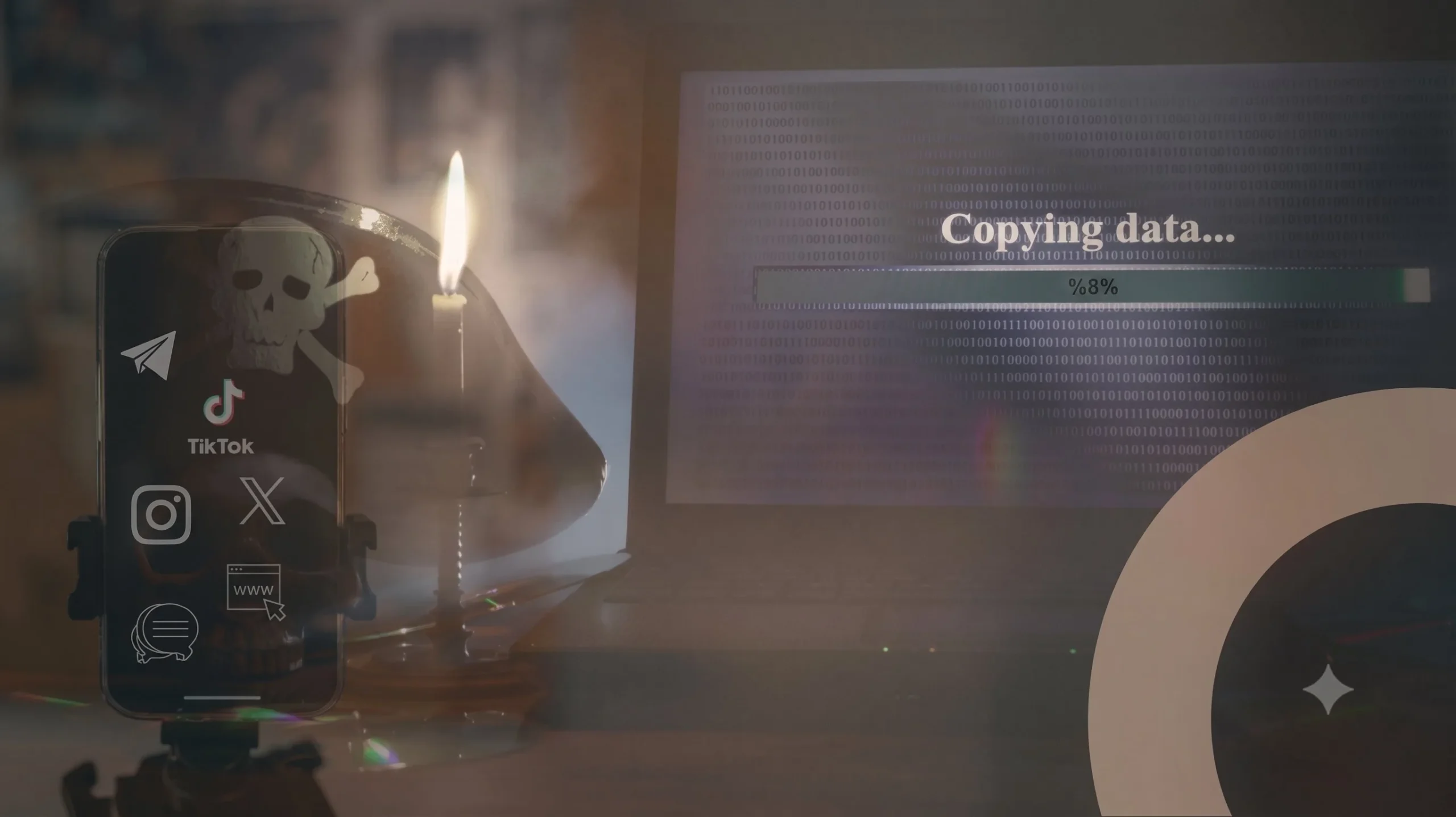
TikTok, however, represents something more significant: evidence that piracy itself has evolved. A platform built on short-form video became a space where full-length films are consumed in fragments. The mechanics are straightforward. A film gets broken into fragments, clips cropped, mirrored, sped up and uploaded across dozens, sometimes hundreds of accounts. A few taps, and the phone in your audience’s hand becomes a remote control for a pirated copy split across 10 to 100 pieces. Billions of views across countless titles. The movies arrived in their feed.
What makes this particularly significant is not just the distribution, it’s the attention. These clips look ordinary. They look harmless. But they are pulling your audience’s focus away from cinemas and official platforms, quietly replacing the viewing habit you built with one you didn’t authorise. Audiences are now watching movies and TV shows in three-minute chunks. That is not a fringe behaviour. It has become, for many, the default.
Telegram, Discord, Reddit: The Infrastructure Built for Scale
Telegram presents a different dimension of social media piracy altogether. Almost every piece of content in circulation has a corresponding channel or group, and within it, direct links to pirated copies. Public channels, private groups, bots that automate distribution, file sharing up to 4GB: the infrastructure is purpose-built for scale. Large files move via links shared inside groups. Telegram functions not as a storage platform but as a distribution hub. Take down a channel, and the source material remains untouched elsewhere. Given how central mobile consumption has become to viewing behaviour, Telegram’s growth as a piracy vector is no longer a niche concern. It is a mainstream one. Thousands of channels continue to distribute, uninterrupted.
Beyond social platforms, however, a parallel infrastructure has been growing. Discord servers, Reddit communities, forum groups: wherever an audience congregates, distribution follows. Unauthorised content moves through the middle of real traffic, in plain sight. Trends shift, and this dark ecosystem shifts with them.
Why Traditional Protection Strategies Are Falling Behind
This is where many protection strategies start falling behind. Piracy has built its infrastructure around the same places your audience already lives, and a protection strategy that doesn’t account for that is, by definition, incomplete. Turning a blind eye to where attention is actually going isn’t a neutral position. It’s a choice that costs revenue.
Treating this as harmless background noise, or worse, as organic marketing support, is a mistake the industry can no longer afford to make.
Controlled virality has a legitimate role. Short-form content can drive audiences toward official platforms, and there is real value in that. But there is a meaningful difference between using social platforms as a booster for your official release and allowing them to become the primary viewing destination. Protection built around that distinction, one that keeps your official distribution channels as the main event while managing the social layer around them, is not only possible, it’s necessary.
A 360-Degree View: How DigiGuardians Tracks Piracy Across Platforms
At DigiGuardians, we follow how audience behaviour and piracy distribution evolve in parallel. Our model is built to track exactly how social media piracy spreads across every platform and how to build protection strategies that work with your distribution model, preserving revenue without disrupting the reach you’ve built. Every unauthorised view is a transfer of value away from where it belongs.
We don’t just watch the known addresses. From a single share that looks harmless to every fragment of attention your content loses along the way, we take a 360-degree view. Where the hype is today may not be where it lives tomorrow. The social media platforms we know now may shift as distribution windows evolve, and new sharing spaces will emerge. Your protection strategy needs to move with that. Agility isn’t optional.
So the question is a simple one: does your current protection strategy see the full picture?